Fragrances & Flavours
See a More Detailed Example
This is how a formula appears on the tablet.
This is the formula displayed on the tablet in manual mode.
The dosage of the first component, Italian Orange Oil, is correct.
The second component, Lemon Oil, is at the limit of acceptability
(Pay attention). The third component, Mandarin, is highlighted in red,
indicating an unacceptable dosage—stop further dosing pending
a decision. The weight cannot be modified.
The fourth component, Tropical, shown on a double line, indicates
that the theoretical batch in the active container is insufficient to
complete the formula. A new batch must be automatically loaded;
the operator only needs to click once to open the nitrogen fill valve.
The inventory must then be updated.
In addition to this screen, for each active dosing operation,
a second dedicated screen appears, very large and clear, displaying
the progressive weight readings transmitted by the scale.
The errors highlighted in the various formulas are those that may occur
when using traditional manual methods without the epicyclic system.


Ball Valves
Ball valves, even if slightly modified, cost significantly less than specialized
actuated valves. Such specialized valves would otherwise require multiple
dosing lines, since high flow rates and large valve diameters make
drop-by-drop dosing impossible. Furthermore, hundreds of these valves
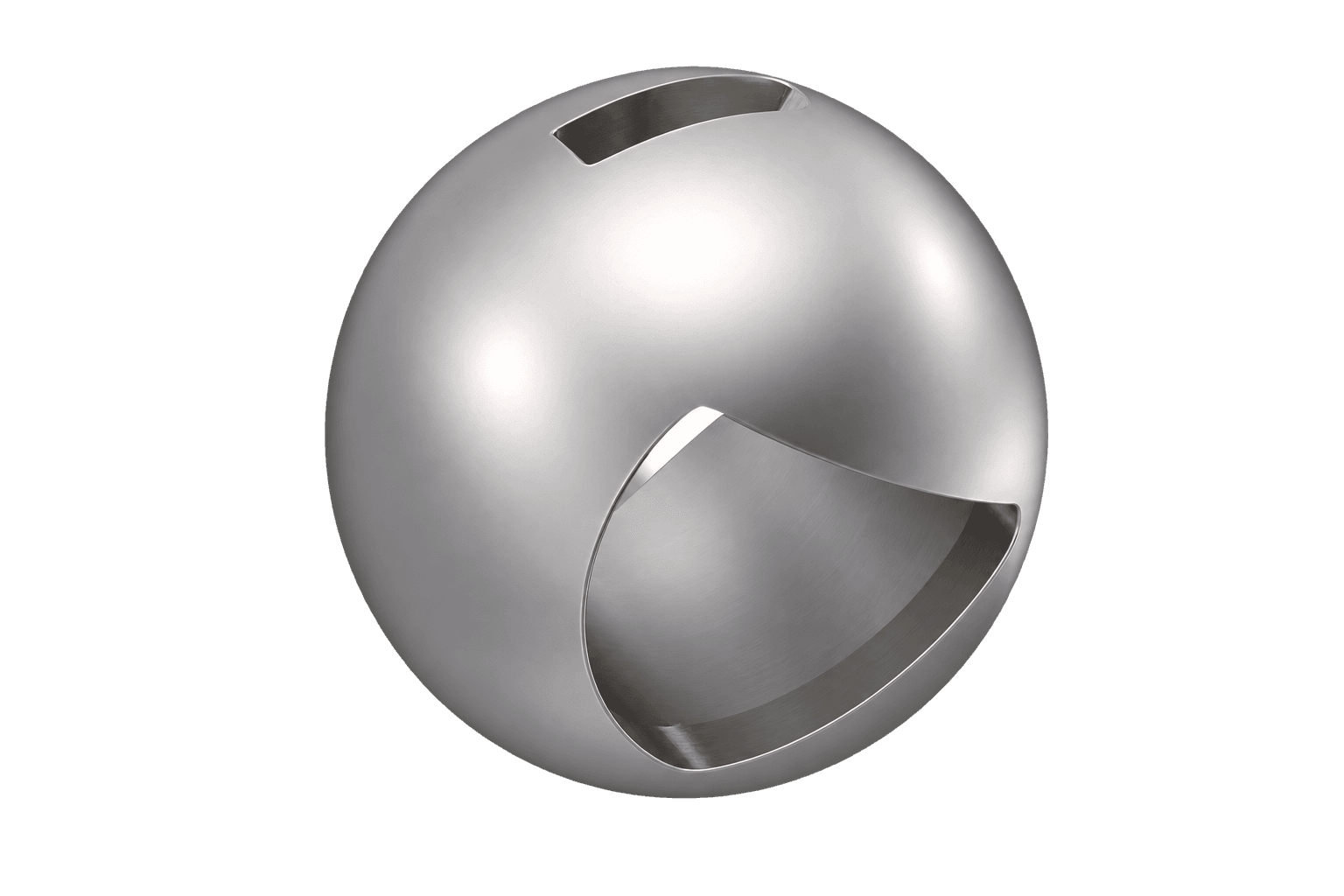
would be required. The standard ball inside the valve is modified
with a V-notch, as shown in the image, to provide a more progressive
opening and improve fine dosing control.
The ball valves will be fire-safe, PED and ATEX certified, and equipped
with pure PTFE (Teflon) seals, with no Viton components.
The dosing line
One dosing line for every batch size, using simple ball valves in different
sizes, typically from ¼″ to 1″ and larger where required.
Standard valve handles are replaced with extended valve shafts allow
simple manual or automatic operation.
Valves are normally arranged in a single row at a 40–50 mm pitch,
allowing approximately 40–50 raw materials to be installed along
the dosing lineand from each shelf.
If required, valve density can be increased by installing a second dosing
line directly behind the first one, at the same level.
The line can be sized to allow multiple AMRs to operate simultaneously.
A shorter valve outlet reduces drip risks and optimizes dosing precision
Alternative dosing-line
With a solution like the one shown in the adjacent image,
a second dosing line can be installed immediately behind
the first one at the same height, with its extended valve
shafts passing through the gaps between the valves
of the front line.
This arrangement makes it possible to practically double
the number of valves along a single dosing line,
without significantly increasing its overall length.
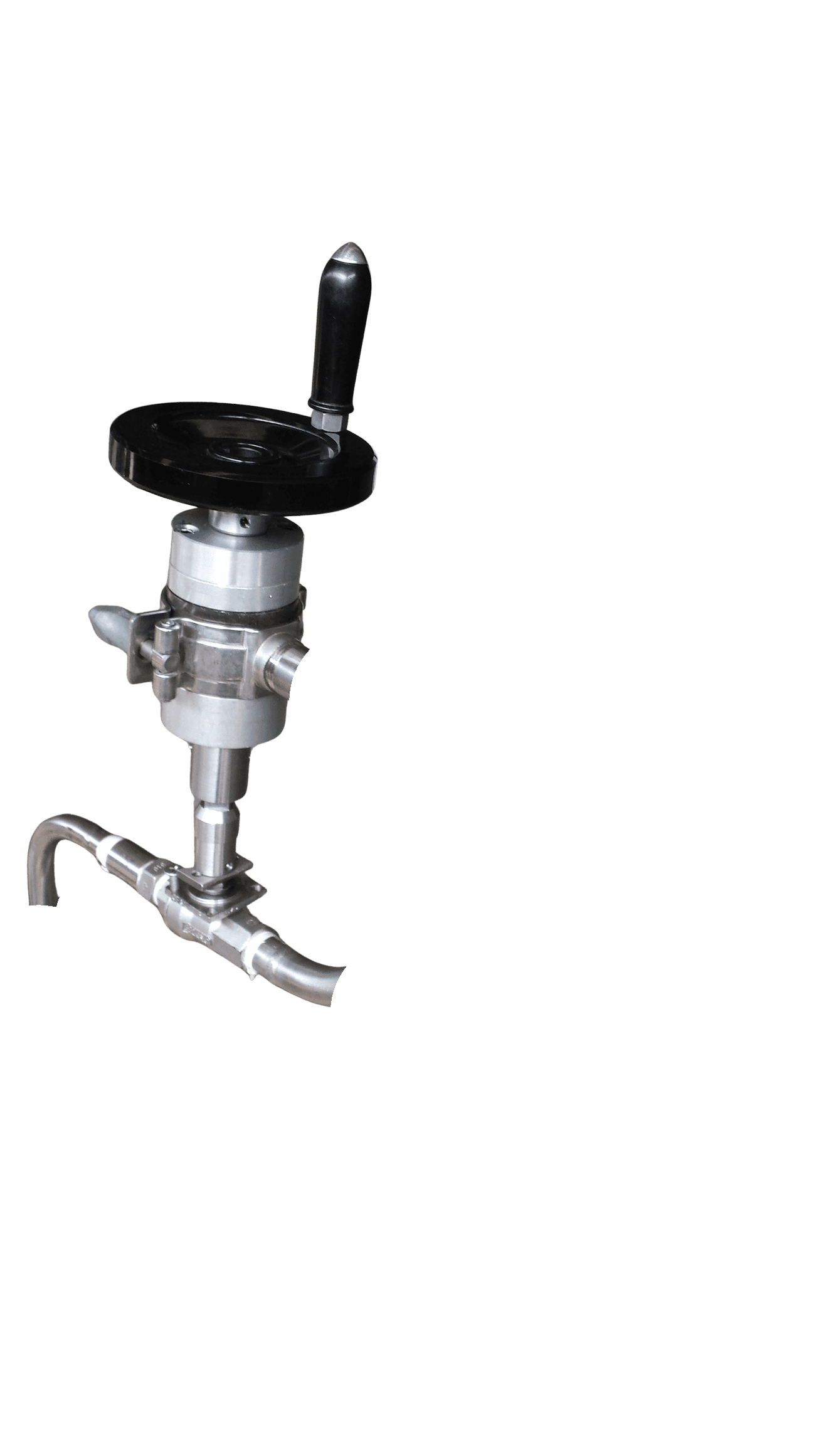
The accuracy secret - an epicyclic gearbox
Simple ball valves reach high dosing accuracy through an epicyclic
gearbox that reduces the valve's 90° rotation by roughly 30–40 times
in manual operation, and by up to 100 times with motorized actuation —
closing the flow passage down to an almost infinitesimal opening.
That gives accurate dosing across the full range,
from full-pipe transfer to extremely small drop-by-drop additions.
Manual precision dosing
Manual dosing requires mobile scales that connect via
Wi-Fi to a tablet or smartphone, which displays all the
instructions needed to prepare a formula.
Tablet receive data from local mixing room software.
The epicyclic gearbox and its rotating hand knob sit
on a sliding support that runs along the valve shaft rail,
so its weight is carried by the rail and it
engages each valve shaft quickly.
The operator simply slides it to the valve they need
— accurate manual dosing without complex
or expensive actuators.
For less critical operations, a simple extended
handle on the valve shaft is enough.
Even in manual mode, partial automation can be easily implemented.
A small motor mounted on the sliding support
guided by a tablet or smartphone camera reading barcode
can automaticallyalign the dosing unit with the target product.
This video shows how the epicyclic system works.
The terminal pipe shown is one of several tested
in an effort to eliminate dripping.
In the end, it was found that the best terminal is the short,
straight one, only 2 cm long equipped with a drip collection cup.
This video was made using standard ball valves
without an internal V-notch.

In addition to this solution, if a higher valve density were
strictly necessary, the second row of valves could be
positioned slightly higher and staggered relative
to the first row, allowing more valves
to be installed within the same length of dosing line.
Full-Pipe or Drop-By-Drop Dosing
Precision Dosing
Fully automatic dosing
Automatic dosing heads slide along the upper rail,
each needing only three small motors: one for horizontal
positioning, one to engage the valve control shaft,
one to rotate the epicyclic reduction system.
Autonomous mobile robots (AMR), similar to those used
in modern automated warehouses,
follow each dosing head with a weighing scale and
receiving container starting the batch, following
the dosing sequence, unloading the finished container,
and returning for the next one.
Clean delivery
The short outlet tube below each valve minimizes drips,
ensuring maximum cleanliness.
Dosing Valves Arrangements
This valve arrangement once again demonstrates the exceptional flexibility
of the system, allowing a very high density of dispensing points.
The rack behind the dosing line can accommodate
up to 100 raw-material containers. The dosing line can operate either
vertically (preferably) or horizontally and, in both configurations, can be
used in either manual or automatic mode. In manual operation,
some precautions are required because the barcode labels
are positioned very close together.
However, a tablet holder could easily be added:
the tablet would display the formula and verify whether
the operator has engaged the correct valve.
Small rack for small companies
For a very small company or artisanal producer,
a simple and cost-effective solution can be adopted,
such as the one shown in the adjacent image,
using the valve arrangement described above.
The system can operate either manually or automatically
and may include one, two, or even three containers racks,
with a total length of 2 to 6 metres,
each accommodating approximately 80 raw materials.
One or two small, high-precision scales can be installed
to travel along guide rails. Accurate drop-by-drop dosing
is ensured by the epicyclic reduction system.
The space above and below the compact rack
can be used to store raw materials required
in very small quantities, occasionally used materials,
or solid ingredients that are not connected to the dosing line.
Less Critical Dosing
For less critical dosing requirements,
good accuracy can also be achieved using valve
balls modified with a V-notch and operated by a
relatively long horizontal control lever,
as shown in the adjacent image.
Alternative Dosing Line Layout
The standard configuration for the dosing line can be linear.
However, where the desired straight-line space is not available,
a U-shaped layout can provide a long dosing line for a large number
of raw materials while allowing many AMRs to work simultaneously.
This solution may reduce the number of racks that can be installed,
but the capacity can be recovered by using stacked racks.